 Wavelens
What it finds · Measured
Following you: a signal that keeps turning up on your route
What it is
A verdict, not a device type. Wavelens has heard the same emitter at several well-separated places over a span of time, lost it for a while, and then heard it again. That pattern is unusual for scenery and for a car that merely shares the road.
Who uses it
Anyone or anything moving on the same route as you: another vehicle, a pedestrian with a phone, a device in your own bag, or a tracker. The verdict says nothing about who or why.
What it can see
The underlying device is whatever its category says. The verdict itself only means the signal and your position have travelled together.
What it can't do
It cannot tell intent. A friend driving behind you, a delivery van on the same street, or your own earbuds in a coat pocket all produce the same pattern.
How Wavelens finds it
Nothing is listed until the device has stayed with you for more than 5 km of driving: a doorbell or a neighbour's phone heard for hours beside a parked car never qualifies. Then: heard at five or more positions well apart over at least twelve minutes, with at least one drop-out of a few minutes before it returned. The drop-out is what separates a tail from the car in the next lane. Needs location to be on. Tails come with a map replay of your path against the device's hits and gaps.
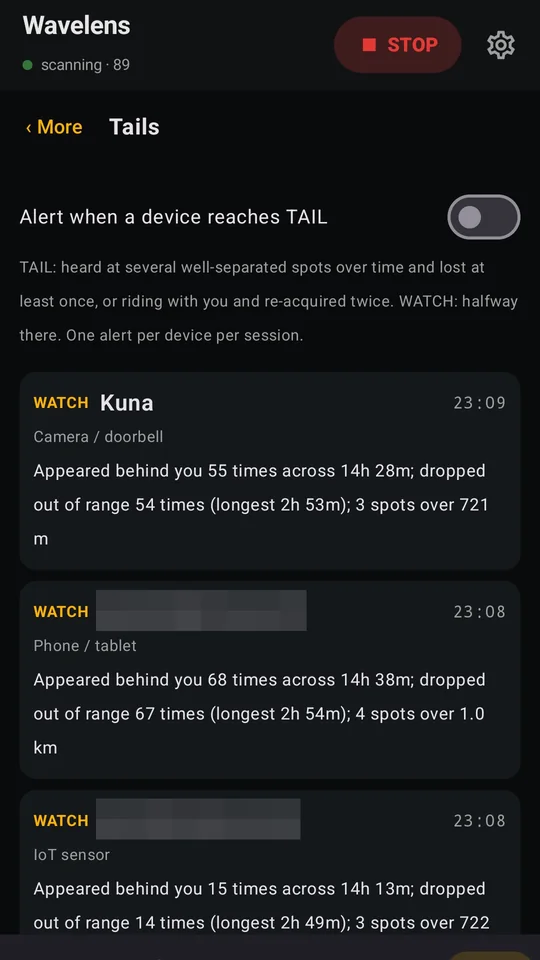
What to do when you see one
Open the card and look at the category, name and history. Mark it "Mine" if it is yours. If it is a tracker and you cannot find it, search bags, pockets and the vehicle; your phone's own unwanted-tracking alert can usually make the tag play a sound.
Phone or companion?
The phone alone detects this over its own Bluetooth and Wi-Fi; no extra hardware is needed. A Spotter companion ($64, ESP32) on the dash hears further and can park on single Wi-Fi channels a phone only visits briefly. Full Spectrum ($499, a Raspberry Pi with RTL-SDRs plus a Spotter) adds sub-GHz sensors and radio, which this kind does not need.
Questions
How does Wavelens decide something is following me?
First the device has to stay with you for more than 5 km of driving, which rules out everything that sits near where you park. Then it needs the same emitter at five or more well-separated places over at least twelve minutes, with at least one drop-out before it came back. That drop-out is what separates a tail from the car in the next lane.
Can it tell who is following me, or why?
No. A friend behind you, a delivery van on the same streets or your own earbuds in a coat produce the same pattern. The card shows the device's category and history so you can judge.
Does it need location turned on?
Yes. The verdict compares each device's signal history with the phone's own movement, so location must be on. It stays on the phone; Wavelens has no network permission.
Related: How to check your car for a hidden tracker · Bluetooth trackers
Get alerted when something keeps turning up behind you
Wavelens scores every emitter against your own route, phone on the dash, and says so out loud when one has followed you through turns and gaps. Everyone who joins the Android beta before the Play Store launch gets the Play version free with a promo code. Offline, no account, no network permission.
Join the free Android beta Hear it a block further: Spotter, $64
Confirmed only when the device describes itself · 282 signatures · nothing leaves the phone
Classification is a best-effort guess from public signature data. Check before you act on it. None of this is a claim about who owns a device, why it is there, or whether it is lawful.
Where this comes from
- Wavelens follow heuristic (Repo.kt)
- Apple Find My network accessory specification; AirGuard (TU Darmstadt) research
Other kinds
- 🏷 Item trackers
- 📷 Plate readers
- 🎥 Body cams
- 🚁 Drones
- 🎙 Acoustic sensors
- 🛠 RF and pentest tools
- 🚦 Traffic sensors
- 🚌 Fleet vehicles
- 📹 Cameras and doorbells
- 🚗 Vehicles
- 📞 Phones
- ⌚ Wearables
Join the free Android beta Hear it sooner: companions from $64